Shape of Belonging

People like to guess where Adam was from.
They would squint at him the way people do when a word is at the tip of their tongue.
“Turkish?”
He would smile. “No.”
“Greek?”
“Not quite.”
“No, wait. North African?”
He would shrug. “Close enough.”
Then came the inevitable: “No, but where are you really from?”
He used to explain it all: the names of two countries that shared little beyond their place on the map, the third he had grown up in, the airports that blurred into his accent. He carried an elusive familiarity, one that echoed different worlds, yet belonged wholly to none. Despite his attempts, to many, the explanation offered no conclusion. They wanted a single defined place, something tidy enough to make sense of. A neat border. He came from the blank spaces between them.
Once, a woman at a party said, “You must feel so exotic.” He almost laughed. “You mean confusing,” he replied. She didn’t get the joke.
With one group, he would lower his voice and season his speech with the right slang. With another, he would flatten his vowels and keep his hands still. He could belong anywhere for a while, as long as no one looked too closely at the fragility of his adaptation, a performance that took more effort than anyone guessed.
He could feel certainty falter in people, the instant they realized he did not align with whatever they had first assumed him to be. The adjustment was usually subtle, barely visible, but never absent. His fatigue was real, a constant dull ache from living at the edge of recognition.
At lunch, conversation turned to news of a capsized migrant boat coming from distant shores. One said, “I just wish people would stay where they belong.”
Adam asked softly, “And where is that, exactly?”
They laughed it off, assuming he was joking.
He wasn’t.
He had tried, long ago.
At a community center downtown, cultural nights filled the air with dancing, music, and food from his father’s side. The smell of cumin and coffee hit him like a memory that wasn’t his.
He stood by a table, smiling awkwardly. A man in a white linen shirt greeted him.
“I don’t think we’ve met before,’ the man said warmly. ‘Family from back home?”
“My father was.”
“Was?” the man echoed. “And your mother?”
“Different place,” Adam said.
“Ah,” the man nodded slowly. “Well, welcome. It’s good to see young people reconnecting.”
Someone handed him a pastry and said, “You know this, right?” He nodded, though he didn’t.
For a while, the space was his. They laughed easily and made room for him, but it was the small questions that began to wear him thin.
“Where did you grow up?”
“Here.”
“Oh, so you don’t speak the language?”
“Not fluently.”
“You must visit home often, no?”
“Which one?” he asked. The man laughed politely.
As the night wore on, the smiles stayed welcoming but thin.
So he tried the other side, his mother’s. Different flag, different music.
At a family event, a distant relative clapped him on the back twice—quick, casual approval that did not bind him to anything. “You look too much like the other half,” he joked.
He smiled faintly. “And you look like you have rehearsed that line.”
The laughter was stiff.
Standing outside under the streetlight, he realized he had no language for the space between belonging and exclusion.
The world liked its boxes tidy. There were rules, some spoken, most left unsaid but deeply understood, for who could claim which heritage or which shade of belonging. When they said none of that mattered, they knew exactly where the lines were drawn, well enough never to cross them. And when they asked where he was really from, the question felt like a firm, polite hand pushing him back across the line.
The melancholy was a lifetime in the making, an invisible layer settled upon him over the years. It wasn’t sharp, just ever-present. At some point, he had taken to looking away, yet his reflection still caught him in passing glass. He was a meeting point for worlds that never merged beyond the personal, and in trying to be part of them all, or even one, he had become part of none.
Sometimes at night, he scrolled through family chats where cousins shared jokes in languages he could barely read. He would type a few words, add an emoji, smile at the screen, then delete the half-formed reply. He wasn’t angry, just unmoored.
He had always noticed how easily others moved through life, certain of their place in it. It looked effortless, like a birthright. He envied that ease, even as he despised it.
At a small café on the corner, a place that played soft jazz and never asked questions, he was a familiar face. The barista, a tired man with gentle eyes, moved easily between words and quiet.
“Your usual?” the barista would ask.
“Thanks,” Adam said with a nod.
He finished his coffee and stayed a while.
“Would you like another?” he asked.
“No, thanks. I need to get some sleep.”
After a pause, Adam smiled. “Do you ever get tired of the same songs?”
“Most times I only notice them when they stop,” he said. “Guess that happens when you’ve been standing behind the same counter long enough.” He wiped the steam wand with a rag. “You from around here?” he asked, more out of habit than curiosity.
“Kind of,” Adam said.
He chuckled. “Aren’t we all ‘kind of’? I’ve got family spread over three different countries. I stopped keeping track a long time ago.”
“Does that ever bother you?” Adam asked.
“Why should it?” He shrugged. “I grew up with all of it. The food, the languages, the stories. I just got more of everything.”
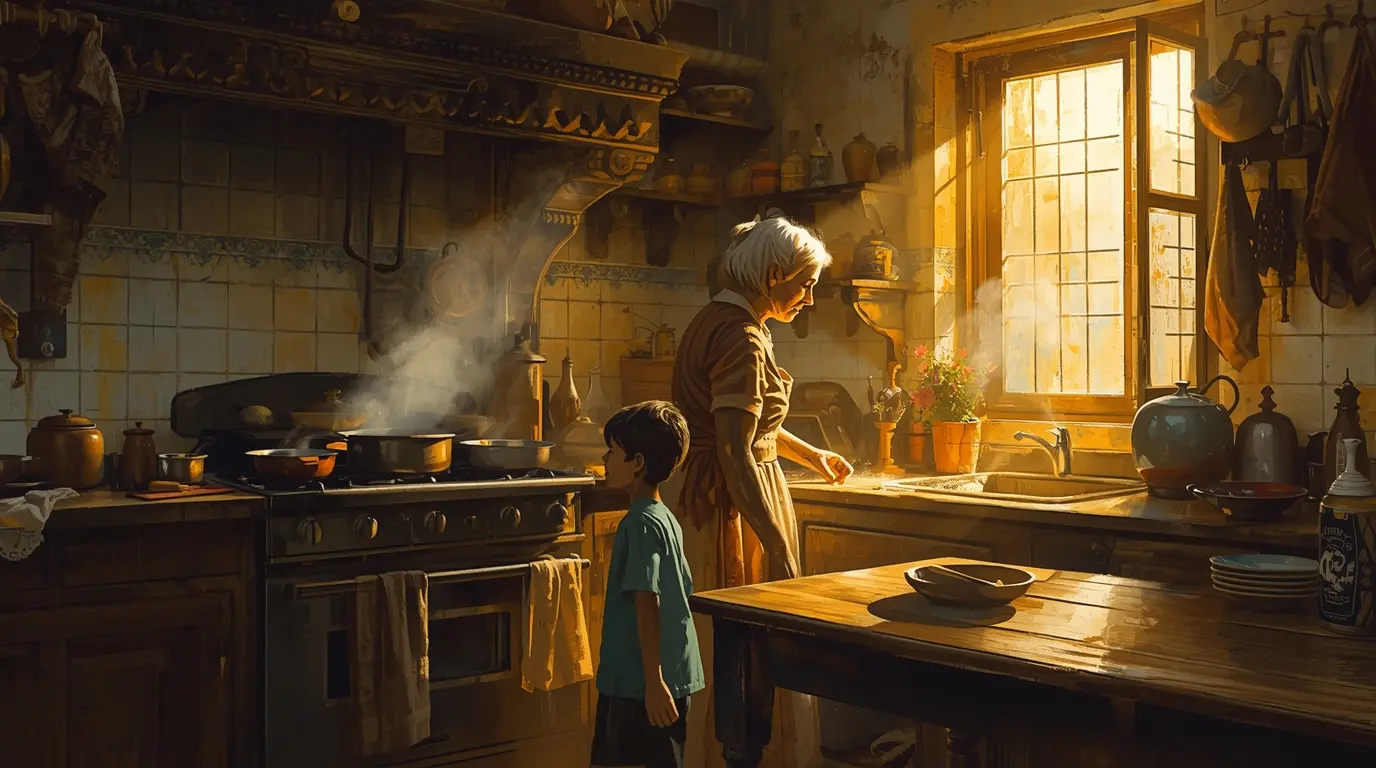
He often thought of his grandmother. She lived in a house filled with a clutter of languages, where people argued about everything. There, he existed without the burden of definition; he was neither questioned nor celebrated. He simply was, an unspoken truth woven into the house itself. She just called him my boy, once in Arabic, once in Spanish, once in a dialect of a village that no longer existed on any map.
When she cooked, she never measured ingredients, just handfuls, pinches, and confident guesses guided by a steady intuition. “That’s how life tastes,” she would say, laughing. “Never quite perfect, always exactly enough.”
He used to think she was impulsive; now he understood she was free.
He dreamt of her standing in her kitchen, stirring something fragrant and tapping the spoon a few times against the pot’s edge. In the dream, she looked at him as though all his uncertainty had already been answered long before he was born.
He woke with both her presence and the aroma of her kitchen still lingering around him, warm and grounding. It felt like proof that he came from everywhere she ever loved, and though he always carried the breadth of that love within him, he could never quite claim it.
In the weeks that followed, something in him began to tilt. He couldn’t name it, not yet, but the old unease had loosened its grip a little. The world started to feel less like a place he had to navigate and more like one he might actually inhabit. The city’s bustle no longer filled him with unease or felt like a world he needed to break into. It was just life moving through the same air he breathed.
Months later, he was walking home. From a nearby corner, someone shouted something he could not catch, maybe a shout meant for someone else, or just noise folded into the street. Once, he would have tensed, braced for the usual questions or remarks he had heard all his life. He didn’t turn to listen, not this time.
While waiting for the bus, two tourists approached.
“Excuse me,” one said, fumbling through words in a language he only half-understood. They asked for directions.
He hesitated for a second, a leftover reflex from lifelong conditioning, but he was surprised by how natural it felt to answer, how unguarded his voice sounded.
He spoke then, words flowing in a messy mix of their language and his own.
“You speak it?” one asked, genuinely surprised.
“Not well enough for language purists,” Adam smiled.
They laughed, thanked him, and walked off.
He stood there, the sound of his own voice still hanging in the air. It was a patchwork of tones and rhythms, but for the first time, it didn’t sound fractured. It sounded full.
For a moment, he felt like the first of his kind, a man made of many beginnings.
For most of his adult life, he tried to mold himself into predefined structures, never realizing that true belonging is not conformity or recognition, but alignment, a coherence between self and world. What he had pursued was its shadow: a surrender, a muted plea to be seen. Peace lay in occupying his own full height, in allowing neither himself nor others to define the borders of his existence.
He thought of every question, every doubtful glance, every moment of feigned familiarity, every but where are you really from? He thought of all the moments of self-doubt when his own voice felt borrowed, and the world’s incessant need to place him.
He weighed those burdens against his innermost clarity, and in the silence of his mind, the sheer absurdity of it all shone through.
A small laugh escaped him, sudden and unguarded. A few passersby glanced over, curious. He didn’t care.
As the bus pulled in, the window caught his reflection against the night, blurred and shimmering, a mosaic of fragments and passing colors. Every fragment was a story, and every border an illusion.
He stepped onto the bus, the doors hissing shut behind him as it roared to life. The night moved, and so did he, belonging not to any one place, but to motion itself.