Shape of Belonging

People liked to guess where Adam was from.
They would squint at him the way people do when a word is on the tip of their tongue.
“Turkish?”
He smiled. “No.”
“Greek?”
“Not quite.”
“No, wait. North African?”
He shrugged. “Close enough.”
Then came the inevitable: “No, but where are you really from?”
He used to explain it all: the names of two countries that shared little beyond their place on the map, the third he had grown up in, the airports that blurred into his accent. His skin carried an elusive shade, dark enough to be foreign everywhere, light enough to belong nowhere. But the explanation always left people unsatisfied. They wanted a single defined phrase, something tidy enough to make sense of. A neat border. He came from the blank spaces between them.
At restaurants, waiters would switch languages mid-sentence, testing him like a code, their eyes lingering with an almost-recognition. On the metro, strangers assumed he spoke their language. When he did correct them, their faces tightened in puzzled frowns, as though he had betrayed an implicit agreement, the same faint disappointment he had seen in the waiters’ eyes when he failed their test.
Once, a woman at a party said, “You must feel so exotic.” He almost laughed, but her tone was too admiring, too self-satisfied. “You mean confusing,” he replied. She didn’t get the joke.
With one group, he would lower his voice and season his speech with the right slang. With another, he would flatten his vowels and keep his hands still. He could belong anywhere for about fifteen minutes, as long as no one looked too closely at the fragility of his adaptation, a performance that took more effort than anyone guessed.
At school, he was “the foreign kid.” At university, “the Global Local.” At work, they settled on “versatile.” He smiled at the title; it sounded less lonely than unrooted. But the fatigue was real, a constant, dull ache from perpetually being both familiar and foreign in the same breath.
At lunch, colleagues talked about news of a capsized migrant boat coming from distant shores. One said, “I just wish people would stay where they belong.”
Adam asked softly, “And where is that, exactly?”
They laughed it off, assuming he was joking.
He wasn’t.
He had tried to belong, long ago.
Downtown, a community center hosted cultural nights, dancing, music, food from his father’s side. The smell of cumin and coffee hit him like a memory that wasn’t his.
He stood by a table, smiling awkwardly. A man in a white linen shirt greeted him.
“You’re one of us?” the man asked.
“My father was.”
“Was?” the man echoed, a trace of skepticism in his voice. “And your mother?”
“Different place,” Adam said.
“Ah,” the man nodded slowly. “Still, welcome. It’s good to see young people reconnecting.”
For a while, the space was his. They laughed easily, made room for him. Someone handed him a pastry and said, “You remember this, right?” He nodded, though he didn’t.
Eventually, the small questions that slowly dismantle him began:
“Where did you grow up?”
“Here.”
“Oh, so you don’t speak the language?”
“Not fluently.”
“You must visit home often, no?”
“Which one?” he asked, and the man laughed politely and turned away.
As the night wore on, the smiles stayed welcoming but thin. He left before the music ended and never felt the pull to return.
So he tried the other side, his mother’s. Different flag, different music.
At a family event, someone clapped him on the back twice—quick, casual approval that did not bind him to anything. “You look too much like the other half,” he joked.
He smiled thinly. “And you look like you have rehearsed that line.”
The laughter was stiff.
Standing outside under the streetlight, he realized he had no language for the space between belonging and exclusion.
The world liked its boxes tidy. There were rules, spoken and unspoken, for who could claim which heritage, which label, which shade of belonging. When people said they “didn’t see race,” what they really meant was they saw its borders everywhere and simply preferred not to speak of it. When they asked “where are you really from,” what they truly meant was: You are not from here, not like us.
The sadness was a lifetime in the making, an invisible layer settled upon him like fog thickening over the years. It wasn’t sharp, just ever-present. At some point, he even avoided mirrors, but his reflection found him in windows and some passing glances. He saw worlds that never merged beyond the personal, and in trying to be part of them, he had become part of none.
Sometimes at night, he scrolled through family chats where cousins shared jokes in languages he could barely read. He typed a few words, added an emoji, smiled at the screen, then deleted half-formed replies. He was not angry, just quietly unmoored and tetherless, like a word missing its sentence.
He had always noticed how easily others moved through life, certain of their place in it. It looked effortless, like a birthright. He envied that ease, even as he despised it.
At a small café on the corner, a place that played soft jazz and never asked questions, he was a familiar face. The barista, a tired man with gentle eyes, moved easily between words and quiet.
“Your usual?” the barista would ask.
“Thanks,” Adam said with a nod.
He finished his drink and lingered a while.
“Would you like another?” the barista asked.
“No, that’s enough if I’m to get any sleep tonight.”
After a pause, Adam smiled. “Do you ever get tired of the same songs?”
“Most times I only notice them when they stop,” the barista said with a tired smile.
“You from around here?” he asked, not out of curiosity but habit.
“Kind of,” Adam said.
The barista chuckled. “Aren’t we all ‘kind of’? My family is from five countries. I stopped keeping count a long time ago.”
Adam looked up and met the man’s eyes. “Doesn’t that bother you?”
“Why should it?” the barista shrugged. “Too many roots make a stronger tree.”
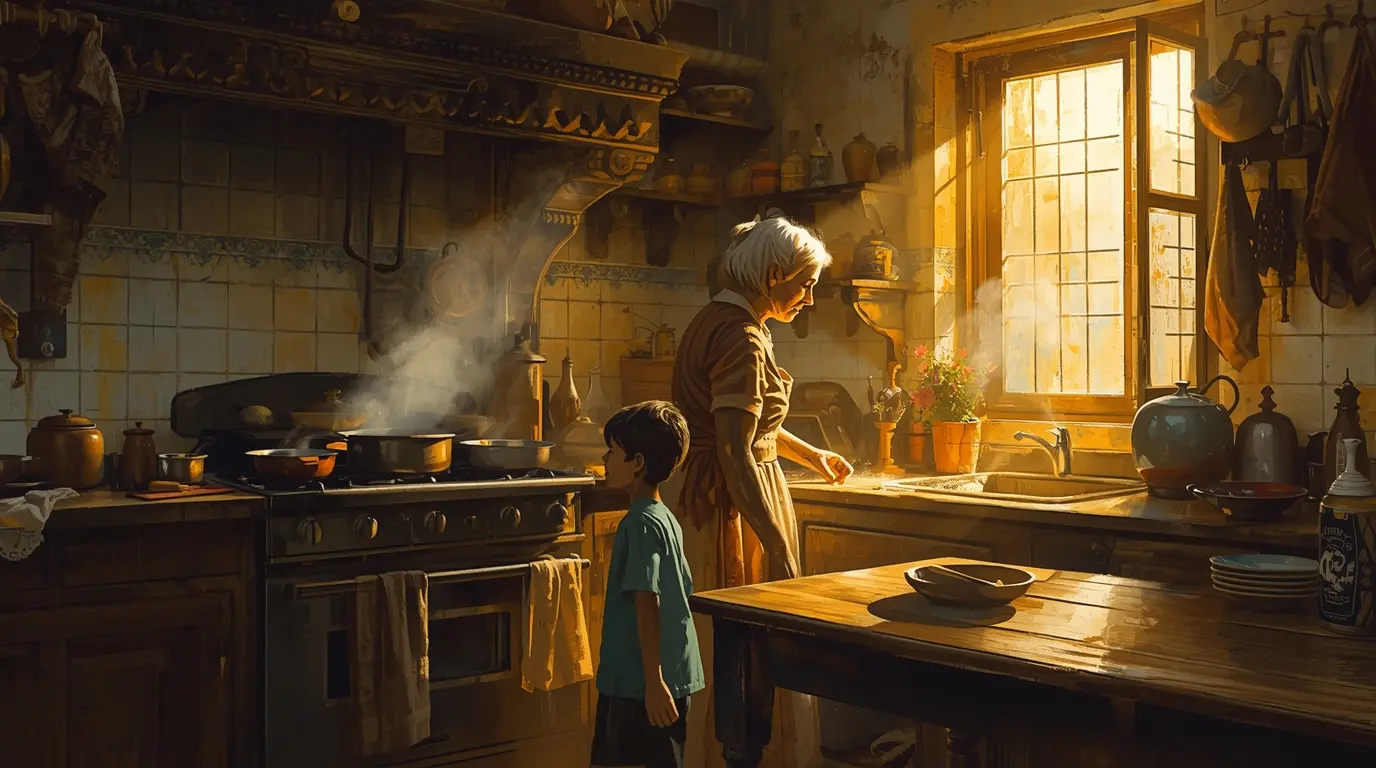
He thought of his grandmother often. She lived in a house filled with many languages, where people argued about everything except where they came from. There, his origins existed without the burden of definition; it was neither questioned nor celebrated. It was simply understood, an unspoken truth woven into that house. She just called him my boy, once in Arabic, once in Italian, once in a dialect of a village that no longer existed on any map.
When she cooked, she never measured ingredients, just handfuls, pinches, and confident guesses guided by a steady intuition. “That’s how life tastes,” she would say, laughing. “Never quite perfect, always exactly enough.”
He used to think she was impulsive; now he understood she was free.
He dreamt of her standing in her kitchen, stirring something fragrant and tapping the spoon a few times against the pot’s edge. He could hear her saying softly that people are always looking for the map on the wall, but life is written in the rhythm of hearts.
He woke up with her voice echoing through the dark. The aroma of her kitchen seemed to linger for hours, warm and grounding. It felt like proof that he came from everywhere she ever loved, a love he always carried but could never quite claim.
In the days that followed, something in him had begun to tilt. He couldn’t name it, not yet, but the old unease had loosened its grip a little. The world started to feel less like a place he had to navigate and more like one he might actually inhabit. He gradually became more tolerant of the city’s ceaseless activity, the bustle and clamor he passed on the street no longer made him tense, no longer felt like a world he needed to break into. It was just life moving through the same air he breathed.
Weeks later, he was walking home. From a nearby corner, someone shouted something he could not quite catch, maybe a shout meant for someone else, or just noise folded into the street. Once, he would have flinched, braced for the usual questions or remarks he had heard all his life. He didn’t turn to listen, not this time.
He was waiting for the bus when two tourists approached.
“Excuse me,” one said, fumbling through words in a language he only half-understood. They asked for directions.
He hesitated for a split second, a moment of instinctive doubt, a leftover reflex from lifelong conditioning, but he was surprised by how natural it felt to answer, how unguarded his voice sounded.
He spoke then, words flowing in a messy mix of their language and his own.
“You speak it?” one asked, genuinely surprised.
“Not well enough for language purists,” Adam smiled.
They laughed, thanked him, and walked off.
He stood there, the sound of his own voice still hanging in the air. It was a patchwork of accents, tones, and rhythms, but for the first time, it didn’t sound fractured. It sounded full.
He felt, for a brief moment, like the first of his kind, a man made of many beginnings.
For most of his adult life, he tried to mold himself into pre-defined structures, never realizing that true belonging is not conformity or recognition, but alignment, a coherence between self and world. What he had pursued was its shadow: a surrender, a muted plea to be seen. The real invigorating power was in being uncontained, in refusing to let others define the borders of his existence.
He thought of every question, every doubtful glance, every moment of feigned familiarity, every but where are you really from? And the world’s endless need to define him.
He weighed those burdens against his innermost clarity, and in the silence of his mind, he found the truth that had always been beneath it all: I am the space between borders, the unclaimed margin of every map.
A small laugh escaped him, sudden and unguarded. A few passersby glanced over, curious. He didn’t care.
As the bus pulled in, he caught his reflection in its glass, blurred, shifting with the city lights. He saw not a divided face, but a mosaic. Every fragment was a story, and every border was an illusion.
He stepped onto the bus, the doors hissing shut behind him. The bus roared to life. The night moved, and so did he, belonging not to any one place, but to motion itself.